

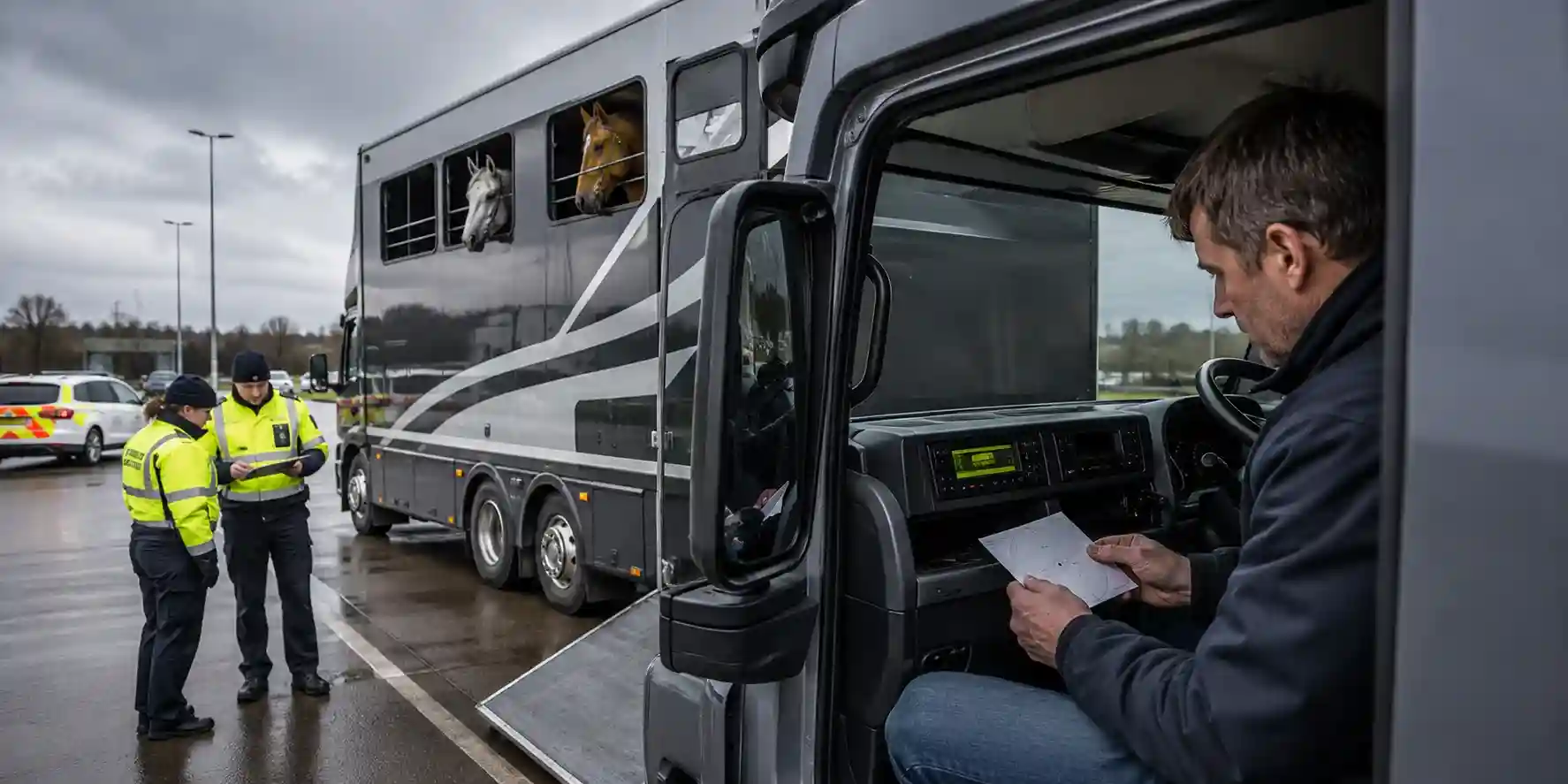
The DVSA horse transport tachograph rules mean UK drivers usually need a tachograph when driving a horsebox or vehicle combination over 3,500kg MAM. Commercial horse transport may also bring drivers’ hours, operator licence, animal welfare, and documentation requirements.
Private leisure drivers may be exempt from some rules, but they must still check licence entitlement, vehicle weight, maintenance, MOT, and horse welfare before travelling.
Key takeaways:
- A tachograph is usually required for horseboxes over 3,500kg.
- Commercial horse transport may need an operator licence.
- Drivers must hold the correct licence category for the vehicle or trailer.
- Horseboxes must not be overloaded.
- Animal welfare rules apply to every horse journey.
- DVSA can issue penalties or impound non-compliant vehicles.
What Are the DVSA Horse Transport Tachograph Rules for UK Drivers?
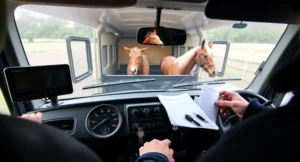
The DVSA horse transport tachograph rules apply mainly to heavier horseboxes and commercial horse transport. A tachograph is a device that records driving time, breaks, rest periods, speed, and distance. It helps DVSA check whether drivers are following the correct drivers’ hours rules.
A horsebox or vehicle-and-trailer combination over 3,500kg will usually need a tachograph. Drivers using smaller vehicles for commercial purposes may also need to follow Great Britain domestic drivers’ hours rules, even where a tachograph is not always required.
Meaning of Maximum Authorised Mass
Maximum authorised mass, often called MAM, is the maximum legal weight of a vehicle or trailer when fully loaded. This includes the vehicle, fuel, driver, passengers, horses, tack, feed, water, and equipment.
Private vs Commercial Horse Transport
Private horse transport usually means taking horses for personal leisure, such as riding, shows, or local events, without payment. Commercial horse transport can include direct payment, indirect payment, business use, prize money, membership fees, or transport included as part of another paid service.
A professional horse transport operator explained the issue clearly:
“I often see drivers focus only on whether they are being paid directly. I always tell them to look at the full journey purpose, because prize money, business use, or transporting someone else’s horse can change the compliance position.”
When Does a Horsebox Need a Tachograph in the UK?
A horsebox usually needs a tachograph when the vehicle weighs more than 3,500kg MAM. This is one of the most important points in the DVSA horse transport tachograph rules because many horseboxes are plated above this weight.
| Vehicle or Use | Tachograph Position | Key Check |
| Horsebox up to 3,500kg for private leisure | Usually not required | Check licence, MOT, weight, and welfare rules |
| Horsebox over 3,500kg | Usually required | Follow drivers’ hours and use tachograph correctly |
| Commercial transport up to 3,500kg | Domestic hours may apply | Check business use and records |
| Commercial transport over 3,500kg | Usually required | Operator licence may also be needed |
Drivers should not rely on the empty weight of the vehicle. The plated MAM is the figure that matters.
Do Private Horse Owners Need to Follow Tachograph Rules?
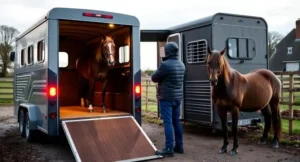
Private horse owners do not always need to follow tachograph rules if they are transporting their own horses for leisure and the vehicle is within the relevant limits. However, they must still follow other legal duties.
These include:
- Holding the correct driving licence category
- Staying within vehicle and trailer weight limits
- Keeping the horsebox or trailer safe and roadworthy
- Having the correct MOT where required
- Following animal welfare rules
- Carrying horse passports and relevant documents
Private use does not remove every responsibility. DVSA can still check vehicle condition, weight, tyres, brakes, load security, and driver entitlement.
What Are the Drivers’ Hours Rules for Horse Transport?
Drivers’ hours rules apply when a driver uses a vehicle over 3,500kg or uses a vehicle for commercial horse transport. These rules control how long a person can drive and when breaks or rest periods are needed.
EU and AETR Rules
EU or AETR drivers’ hours rules may apply to goods vehicles over 3,500kg, depending on where the journey takes place. These rules are stricter and usually require accurate tachograph records.
Great Britain Domestic Drivers’ Hours Rules
If a vehicle weighs 3,500kg or less but is used for commercial purposes, the Great Britain domestic drivers’ hours rules for goods vehicles may apply. This can affect riding schools, professional yards, competition businesses, and horse transport services.
| Rule Area | Applies To | Driver Responsibility |
| EU rules | Many heavier vehicles in scope | Record driving, breaks, and rest |
| AETR rules | Certain international journeys | Follow international drivers’ hours |
| GB domestic rules | Some commercial use under 3,500kg | Keep within domestic limits |
| Tachograph records | Vehicles requiring tachograph use | Use driver card and make entries correctly |
When Is an Operator Licence Needed for Horse Transport?
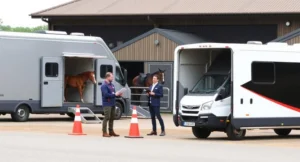
An operator licence is usually needed when a horsebox or horse trailer is used for commercial purposes and the combined gross plated weight is over 3,500kg in the UK or internationally. For journeys in Europe, the threshold can be over 2,500kg.
Commercial purposes can include being paid to transport horses, receiving indirect payment, transporting horses as part of a business, or gaining payment connected with the journey.
A yard manager described this common mistake clearly:
“I used to think an operator licence was only for haulage companies. I now check every journey against ownership, payment, vehicle weight, and destination before deciding what rules apply.”
Which Type of Operator Licence Does a Horse Transport Driver Need?
The type of operator licence depends on who owns the horses, where they are being transported, and whether the transport is commercial.
Restricted Operator Licence
A restricted operator licence may be needed when the operator transports their own horses using a vehicle or combination over 3,500kg MAM within the UK and EU.
Standard National Operator Licence
A standard national licence may be needed when the operator transports horses they do not own within the UK.
Standard International Operator Licence
A standard international licence may be needed when the operator transports horses they do not own outside the UK.
| Licence Type | Typical Use | Key Condition |
| Restricted licence | Own horses | UK and EU use, over 3,500kg MAM |
| Standard national | Other people’s horses | UK-only transport |
| Standard international | Other people’s horses abroad | International transport |
| No operator licence | Non-commercial leisure use | Still check weight and safety duties |
DVSA can carry out roadside checks and may take enforcement action if the correct operator licence is not held.
What Driving Licence Is Needed to Drive a Horsebox or Tow a Horse Trailer?

The correct driving licence depends on the size and weight of the horsebox or trailer and when the driver passed their test. A horsebox is usually treated as a medium or large vehicle when it is over 3,500kg.
For horseboxes over 3,500kg MAM, the driver will usually need an HGV licence. Some Driver Certificate of Professional Competence tests may also be required, especially where driving is the main part of the job.
For towing, drivers who passed before 1 January 1997 can usually drive a vehicle and trailer combination up to 8,250kg MAM. Drivers who passed from 1 January 1997 can usually tow a trailer up to 3,500kg MAM, but heavier combinations may require an HGV licence.
What Rules Apply to Horseboxes Over 3,500kg?
Horseboxes over 3,500kg are where many DVSA rules become more serious. These vehicles usually need the correct HGV driving entitlement, tachograph use, drivers’ hours compliance, annual testing, and heavy goods vehicle-style walkaround checks.
Drivers should also remember that horseboxes must follow speed limits for goods vehicles. This can be different from ordinary car speed limits, especially on single and dual carriageways.
| Requirement | Horsebox Over 3,500kg |
| Driving licence | HGV entitlement usually needed |
| Tachograph | Usually required |
| Drivers’ hours | EU or AETR rules may apply |
| MOT/testing | Annual test for heavier vehicle |
| Safety checks | HGV daily walkaround checks |
| Speed limits | Goods vehicle limits apply |
What Rules Apply When Towing a Horse Trailer with a Car?
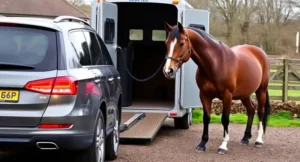
Drivers towing a horse trailer must check the towing limit of the car, the plated weight of the trailer, and the combined MAM. The trailer must not be overloaded, and the load must be safe for the horse and other road users.
Regular checks should include tyres, brakes, lights, coupling, breakaway cable, floor condition, partitions, breast bars, and ramps. Even a well-maintained trailer can become unsafe if the floor weakens or if the horse’s weight causes overloading.
What Horsebox and Trailer Maintenance Checks Are Required?
Horsebox maintenance is a major part of DVSA compliance. Horseboxes need an MOT or annual test depending on their weight. Drivers should also carry out regular servicing and daily safety checks.
Important checks include:
- Tyres, lights, brakes, mirrors, and steering
- Loading ramp condition and security
- Internal stalls, partitions, and breast bars
- Floor condition under mats or plates
- Trailer coupling and breakaway cable
- Signs of damage, corrosion, or weakness
Horse trailers should be checked before every journey. A free trailer safety check may be available for trailers up to 3,500kg through approved schemes.
What Animal Welfare Rules Must Drivers Follow When Transporting Horses?
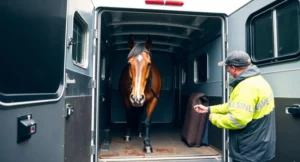
Drivers must not transport a horse in a way that causes harm, injury, or distress. The horse must be fit to travel, safely loaded, and transported in suitable conditions.
For commercial journeys of 65km or more, an animal transport certificate of competence may be required. For journeys over 8 hours, additional qualification and authorisation requirements may apply.
Welfare planning should include space, ventilation, rest, water, emergency arrangements, and suitable breakdown cover. Drivers should make sure recovery includes the trailer and the horses, not just the vehicle.
What Documents Are Needed for Horse Transport in the UK and Abroad?
Drivers should carry the correct documents for the journey. The documents needed can change depending on whether the journey is domestic, commercial, or international.
| Document | When It May Be Needed |
| Horse passport | For horse identification and travel |
| Transporter authorisation | Commercial animal transport |
| Certificate of competence | Commercial journeys of 65km or more |
| Operator licence documents | Commercial transport above thresholds |
| Tachograph records | Vehicles in tachograph scope |
| Trailer registration certificate | Some European journeys |
| International border documents | Cross-border HGV and trailer movement |
Missing documents can create delays, enforcement issues, or welfare problems if the journey is interrupted.
How Can UK Drivers Avoid DVSA Penalties When Transporting Horses?
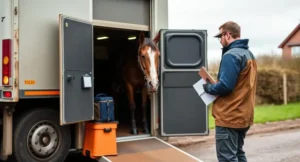
Drivers can reduce the risk of fines, prosecution, or vehicle impounding by checking the rules before every journey. The safest approach is to work through the vehicle, driver, journey, and horse welfare requirements together.
Key actions include checking the plated MAM, confirming whether the journey is commercial, using a tachograph when required, following drivers’ hours rules, keeping maintenance records, and carrying the correct documents.
Conclusion: Why Do DVSA Horse Transport Tachograph Rules Matter?
The DVSA horse transport tachograph rules matter because they protect drivers, horses, passengers, and other road users. A horsebox may look like a leisure vehicle, but once it is over 3,500kg or used commercially, it can fall under stricter transport rules.
UK drivers should check licence entitlement, tachograph requirements, operator licensing, drivers’ hours, maintenance, weight limits, and animal welfare before setting off. Good compliance helps avoid DVSA penalties and makes every horse transport journey safer.
FAQs About DVSA Horse Transport Tachograph Rules
Is a tachograph always needed in a horsebox?
No, a tachograph is not always needed. It is usually required when the horsebox or vehicle combination is over 3,500kg MAM. Smaller private leisure vehicles may not need one, but other rules still apply.
Can a private horse owner drive without an operator licence?
A private horse owner may not need an operator licence when transporting horses for non-commercial leisure use. However, they must still check vehicle weight, driving licence entitlement, MOT, insurance, and welfare rules.
Does prize money make horse transport commercial?
Prize money can be treated as payment connected with the journey, so it may make the transport commercial. Drivers should consider whether the journey creates a direct or indirect financial benefit.
What happens if a horsebox is overloaded?
An overloaded horsebox can be dangerous and illegal. DVSA may issue penalties, stop the journey, or take further enforcement action. Overloading can also affect braking, steering, tyres, and horse welfare.
Are horseboxes treated as goods vehicles for speed limits?
Yes, horseboxes must follow speed limits for goods vehicles. Drivers should not assume that normal car speed limits apply, especially when using heavier horseboxes.
Does a 3.5-tonne horsebox need an MOT?
Yes, a horsebox weighing 3,500kg or less needs the correct MOT. Horseboxes over 3,500kg are subject to the appropriate annual test for heavier vehicles.
What documents should be carried when transporting horses?
Drivers may need horse passports, transporter authorisations, operator licence documents, tachograph records, certificates of competence, trailer registration documents, and international travel papers, depending on the journey.