

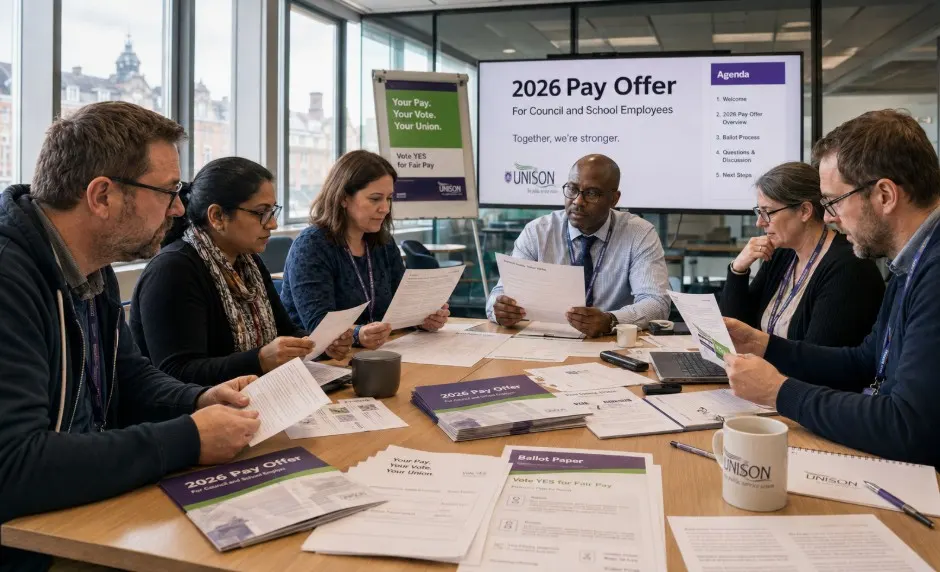
The UNISON Pay Rise 2026 has not been directly rejected by union members, but the union itself has formally rejected the Local Government (NJC) employers’ 3.3% pay offer for 2026/27.
As a result, UNISON is balloting members in selected councils and schools across England, Wales, and Northern Ireland to determine whether they support industrial action. The dispute centres on the gap between the employers’ offer and the union’s demand for a more substantial pay settlement.
Key Points
- UNISON has rejected the employers’ 3.3% pay offer.
- The union is seeking £3,000 or 10%, whichever is greater.
- A £15 per hour minimum rate remains part of the claim.
- Industrial action ballots are taking place in affected workplaces.
- The outcome could influence future pay negotiations and potential strike action.
Has the UNISON Pay Rise 2026 Actually Been Rejected by Union Members?

Not exactly. The current position is that UNISON’s negotiating body has rejected the employers’ pay offer, but members are still being consulted through strike ballots.
Many headlines can create confusion. A rejected pay offer does not automatically mean members have voted against it. Instead, it means the union believes the offer falls short of what workers deserve and is seeking support for further action.
In the case of the UNISON Pay Rise 2026, the dispute centres on the 3.3% increase offered to local government and school staff. UNISON argues that the proposal does not adequately address ongoing cost-of-living pressures or years of below-inflation pay settlements.
“”The NJC Committee has rejected the employers’ 3.3% pay offer because it falls significantly short of the union’s claim for council and school workers. Members are now being asked to support the campaign for a better settlement through the ballot process.” — UNISON Council and School Pay Campaign”
The strike ballot is therefore the next stage in the campaign rather than a confirmation that members have already rejected the offer.
Why Did UNISON Reject the 3.3% Local Government Pay Offer for 2026/27?
UNISON rejected the 3.3% offer because it falls far below the union’s original claim. The union, alongside other unions, had submitted a claim for at least £3,000 or 10% on every pay point, whichever is greater. It also called for a minimum hourly rate of £15, a shorter working week and an extra day of annual leave.
The employers’ offer would raise the lowest hourly rate to £13.28, which remains below the £15 minimum UNISON is seeking. For many lower-paid council and school workers, the union believes a percentage-only offer does not deliver enough meaningful improvement.
Pay offer comparison:
| Area | Employers’ Offer | UNISON Claim |
| Basic pay increase | 3.3% on all pay points | £3,000 or 10%, whichever is greater |
| Minimum hourly rate | £13.28 | £15.00 |
| Working week | No major improvement stated | Two-hour reduction |
| Annual leave | No major improvement stated | One extra day |
This gap between the offer and the claim explains why UNISON is encouraging eligible members to vote in favour of action.
The union’s message is that a stronger mandate could increase pressure on employers to return with a better deal.
What Pay Rise Is UNISON Demanding for Council and School Staff in 2026?

UNISON’s 2026 pay claim is designed to deliver a stronger uplift for lower-paid workers rather than relying only on a percentage increase. A flat percentage rise can give larger cash gains to higher-paid staff while doing less for those on the lowest pay points.
£3,000 or 10% Increase: Understanding UNISON’s Core Pay Claim
The demand for £3,000 or 10%, whichever is greater, is intended to protect lower-paid workers. For someone on a modest salary, a £3,000 rise may be worth more than 10%. For higher salaries, 10% may be the larger figure.
Example impact:
| Current Salary | 3.3% Offer | £3,000 Increase | 10% Increase |
| £20,000 | £660 | £3,000 | £2,000 |
| £25,000 | £825 | £3,000 | £2,500 |
| £35,000 | £1,155 | £3,000 | £3,500 |
These examples show why UNISON argues that the employers’ offer may not deliver enough support for workers on lower and middle incomes.
The £15 Minimum Hourly Rate and Other Employment Improvements
The £15 hourly rate is a central part of the claim. UNISON argues that council and school workers should receive pay that reflects the essential nature of their work, especially in roles such as school support, social care, cleaning, catering, administration and local authority services.
Additional Requests Beyond Pay
UNISON’s claim also includes employment improvements beyond salary. These include a two-hour reduction in the working week and one additional day of annual leave. These demands reflect wider concerns about workload, burnout and retention across public services.
How Will the UNISON Strike Ballot Process Work in 2026?
The strike ballot process is the formal route through which members decide whether they support industrial action.
For the 2026/27 NJC dispute, targeted ballots are taking place across selected councils and schools in England and Wales from 9 July to 6 August 2026, with Northern Ireland expected to follow later in autumn.
Ballot process overview:
- Eligible members receive ballot information from UNISON.
- Members vote on whether they support industrial action.
- The union must meet legal ballot requirements before action can proceed.
- A successful vote does not always mean immediate strikes, but it gives the union a stronger negotiating mandate.
The process is important because UK industrial action must follow strict legal steps. This includes balloting the correct members, achieving the required thresholds and giving proper notice before any strike action takes place.
““UNISON is encouraging eligible members to vote in the industrial action ballot to demonstrate the strength of feeling across local government and school workplaces regarding the 2026/27 pay offer.” — UNISON National Local Government Committee Representative”
For workers, the practical message is simple: check official union communications, confirm ballot eligibility and return the ballot before the deadline.
Which Workers Are Affected by the UNISON Pay Rise 2026 Dispute?

The dispute mainly affects workers covered by the National Joint Council arrangements for local government services. This includes many council and school-based employees across England, Wales and Northern Ireland.
Local Government Employees Covered by the NJC Agreement
NJC-covered workers may include staff in administration, housing, libraries, waste services, environmental health, social care support, customer services and other council functions. These workers are often central to the delivery of local public services.
School Support Staff and Education Workers
School support staff are also a major part of the dispute. Teaching assistants, cleaners, caretakers, catering staff, administrative staff and other support roles may be affected where they are covered by NJC arrangements.
The dispute is especially relevant because many of these roles are lower-paid but essential. If industrial action takes place, it could affect services in schools and councils, depending on where mandates are achieved.
What Could Happen If UNISON Members Vote for Industrial Action?
If members support industrial action and legal thresholds are met, UNISON could proceed with targeted strikes or use the result to seek improved negotiations. A strong ballot outcome often increases pressure on employers to return to the negotiating table with a revised proposal.
Potential outcomes after the ballot:
| Ballot Result | Likely Meaning | Possible Next Step |
| Strong yes vote with legal threshold met | UNISON gains strike mandate | Targeted strike action or renewed talks |
| Yes vote but threshold not met | Limited legal route to action | Continued campaigning |
| No vote | Members reject strike escalation | Union may review strategy |
| Improved offer before action | Negotiations shift | Members may be consulted again |
“A successful ballot would send a clear message to employers that workers expect a more meaningful pay award and that the current offer does not adequately address recruitment, retention, and cost-of-living challenges.” — Senior UNISON Local Government Official”
The impact would depend on which employers are involved, how many members vote and whether UNISON decides to call action.
What Does the Future Look Like for the UNISON Pay Rise 2026 Campaign?
The future of the UNISON Pay Rise 2026 campaign depends heavily on the ballot results and employer response. If UNISON secures strong support, pressure may increase on local government employers to improve the 3.3% offer.
There are several possible paths. Employers could maintain the existing offer, propose a revised settlement or enter further negotiations. UNISON could also intensify campaigning if members back industrial action.
The dispute also sits within a wider public sector pay context. NHS Agenda for Change staff received a 3.3% award from April 2026, while higher education pay negotiations remain difficult. UNISON has criticised settlements that it believes fail to repair real-terms pay erosion across public services.
For members, the most important next step is to follow official campaign updates, vote where eligible and understand how the dispute affects their role and employer.
Conclusion
The UNISON Pay Rise 2026 has not been finally rejected by all union members, but UNISON has rejected the employers’ 3.3% NJC offer for 2026/27. The dispute has now moved into a critical ballot stage, with selected council and school workers being asked whether they support industrial action.
UNISON is pushing for a higher settlement of £3,000 or 10%, a £15 minimum hourly rate, shorter working hours and extra annual leave. The outcome will depend on member participation, legal ballot requirements and whether employers improve their offer.
FAQs About UNISON Pay Rise 2026
What is the difference between a pay offer rejection and a strike ballot?
A pay offer rejection means the union does not accept the employers’ proposal. A strike ballot is the legal process where eligible members vote on whether they support industrial action.
Does the 3.3% pay offer apply to all NJC pay points?
Yes, the employers’ offer is described as a flat 3.3% increase across all NJC pay points for 2026/27.
When are the UNISON 2026 ballot results expected?
For England and Wales, the targeted ballot runs from 9 July to 6 August 2026, so results would be expected after the ballot closes.
Can employers improve the offer before strikes happen?
Yes. A stronger ballot result may increase pressure on employers to reopen talks and improve the offer before strike action takes place.
How does the £15 minimum hourly rate compare with the current offer?
The rejected 3.3% offer would create a bottom rate of around £13.28 an hour, while UNISON is seeking a £15 minimum hourly rate.
Will a successful ballot automatically lead to strike action?
No. A successful ballot gives the union a legal mandate, but UNISON would still decide when and how to call action after following notice requirements.
Where can workers find official updates on the campaign?
Workers should follow the UNISON Council and School Pay portal and official employer communications for confirmed campaign updates and ballot results.